Civilization Chronicles
A chat script and a translator’s draft
How init.ai let developers label both sides of a chat and Google Translator Toolkit let translators revise a machine draft before publishing.
A customer says an order never arrived. Before a support bot can help, someone has to teach it that the order number and the request are two different things. init.ai gave developers a chat editor to do that work. Google Translator Toolkit put the editor at a different point in the process. The translator started with a machine draft and decided what readers would see.
init.ai let builders write both sides of the chat
The design of init.ai grew out of a conversational banking project. Co-founder Trevor McNaughton recalls that building the tools underneath the app became a project of its own. Developers needed a way to create realistic exchanges, identify the purpose of a message and mark the details the system would need later. McNaughton’s init.ai case study.
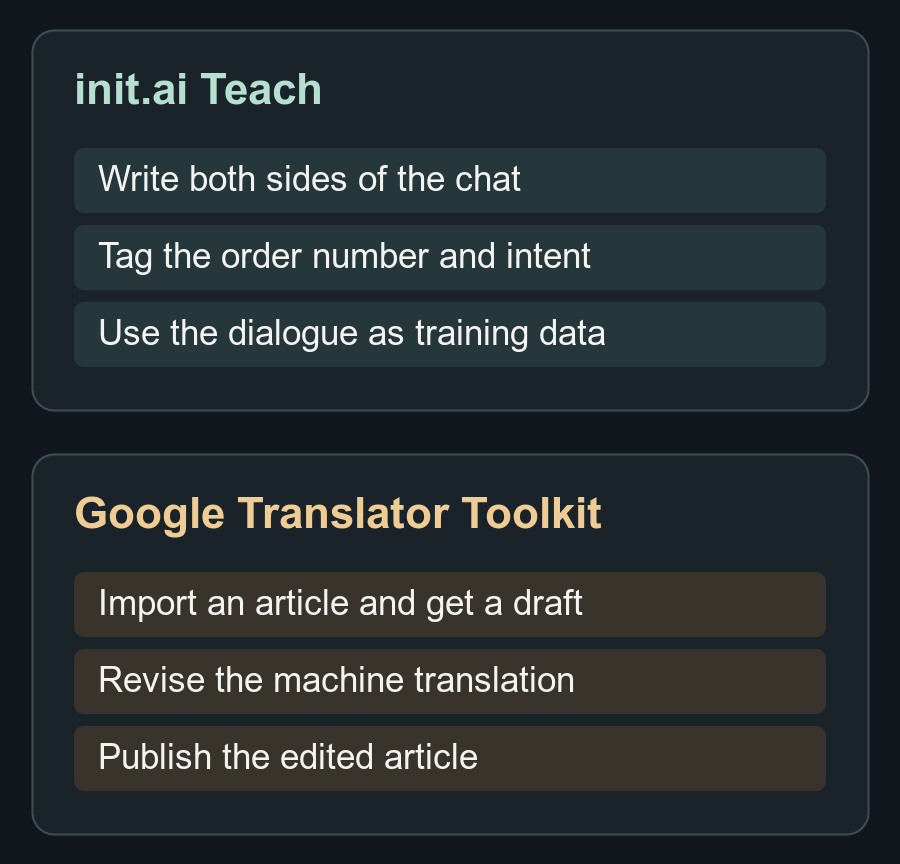
The team started with Conversational Markup Language, a format for writing dialogues across several turns and labeling parts of the text. In McNaughton’s order-status example, the order number is marked as a piece of information the app should pick up. The request to find the order’s status has its own label. The sample reply shows the same order number alongside a delivery date.
The team later built an editor that looked like a chat. A developer could play the customer and the assistant, labeling details inline as the exchange took shape. For a support conversation, this let them see when the customer supplied the order number and what the assistant should say once it had the information. The annotations became training data for a model. init.ai archive.
Google Translator Toolkit put an automatic first pass in an editor
In Google’s 2009 launch example, a person translating a Wikipedia article into Arabic could load the article, get a machine-generated draft, correct it and publish the result. The editor offered translation search, bilingual dictionaries and ratings alongside the text. It handled formats including Word and HTML, and offered terminology and translation-memory management for professional workflows. Google’s launch announcement.
A translator could look up an unfamiliar term and correct a sentence without leaving the editor. Translation memory also gave professional users a place to manage earlier translations. Google described corrections as feedback its translation system could learn from. The action the user controlled in the launch example was publication of the edited Wikipedia article.
What the editors made visible
One editor made it possible to work out what a message meant and which parts of it mattered to an application. The other let a translator follow a sentence from a machine draft to a human revision. Both left an artifact human readers could inspect while the work was still in progress.
McNaughton confirms that init.ai closed in December 2017. Google closed Translator Toolkit on December 4, 2019, and kept Toolkit data available through Takeout until December 4, 2022. Google Translate continued separately. Google Translator Toolkit archive · Google’s closure notice.