Civilization Chronicles
A glossary, a sidebar and a project
How IWI shared Japanese proofreading rules and how VARCO Translation and VARCO Voice organized results in sidebars, histories and projects.
A team proofreading a Japanese document needs to decide which wording to keep. A translator working on an image needs to find the result. Someone who made a voice clip needs to know whether to look in generation history or in the project where it was made. Three retired tools made those tasks visible in different ways.
IWI put the team's wording rules beside the draft
In IWI's Japanese proofreading tool, you could type text into the editor or import a Word, Excel or PowerPoint file. The service extracted the text for review. IWI’s November 2023 release distinguished basic error checks from contextual suggestions. Basic checks looked for errors such as typos and repeated negatives. Context-based checks suggested changes where the wording did not fit the surrounding text.
The paid version gave a team control over what counted as a useful warning. A shared glossary could add terms for the checker to flag or suppress checks the team did not need. Teams of at least two paid users could share their proofreading rules. A reviewer could save one rule set for a public notice and another for an internal draft. Public-document checks could cover conventions for writing loanwords and choosing between kanji and kana. During the beta, the Tokyo Stock Exchange evaluated the tool in its document-review work. IWI described that as a trial. IWI’s November 2023 release.
IWI confirmed in a July notice that the service ended on March 31, 2026. The archive also records what happened to the old service domain. IWI Japanese Proofreading Tool archive.
VARCO Translation put different results in different places
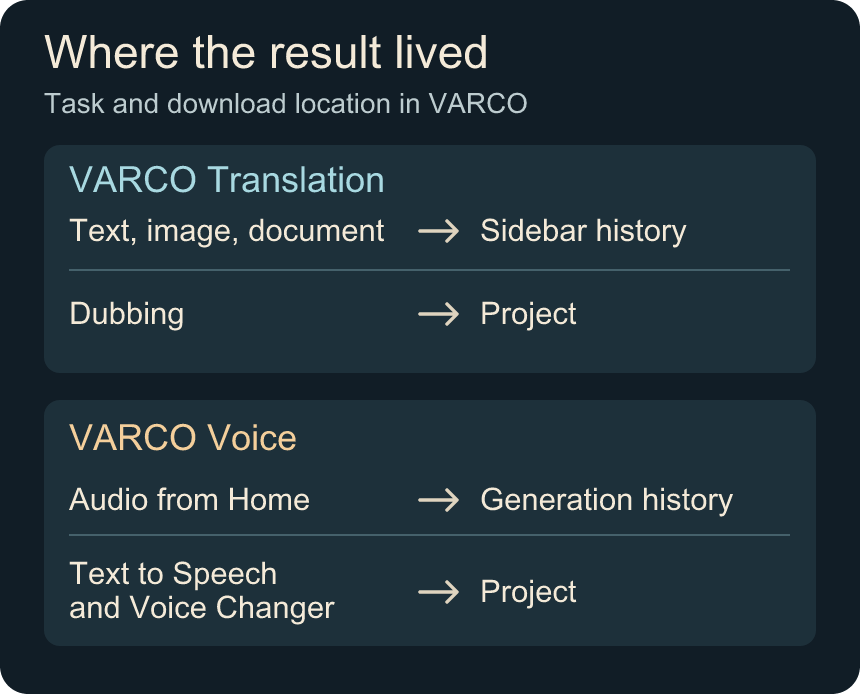
NC AI's VARCO service notice left behind a short map of where the results lived. For a text, image or document translation, a user went to the history in the right sidebar. For a dub, the user downloaded the result from its project.
This mattered when a user came back to save the work. Someone who had translated a document looked for the job in the sidebar history. Someone who had worked on a dub reopened the project. The notice documents where each result could be retrieved. VARCO Translation archive.
VARCO Voice distinguished a quick result from a project
The same notice gives two paths for VARCO Voice. Audio made or converted from the home screen was downloadable from generation history. In the dedicated text-to-speech and voice-changer tools, the download lived inside the project. That was a distinction within one service. How a piece of audio was made determined where the user went to get it back. VARCO Voice archive.
VARCO Voice and VARCO Translation both ended on October 8, 2026, at 18:00 Korean time. The operator kept the wider platform and other services separate from that closure. The download instructions survive in the original notice.
A shared glossary and a download path answer different questions. One tells a reviewer whose terminology to follow. The other tells a creator where the work went. Both are practical details of how these tools fitted into people's work.