Civilization Chronicles
The airport's vocabulary and the phone's shortcuts
How NariTra preserved the words travelers needed at Narita and Ohanashi Assistant carried spoken requests into the apps on au Android phones.
A train line can be the one word that matters in a sentence spoken at an airport. A message starts to take shape when the phone has the recipient ready. Two early smartphone apps in Japan show what happened when their makers designed speech input around those particulars.
NariTra carried the words travelers needed at Narita
On December 26, 2011, Narita International Airport began offering NariTra as a free download for travelers. It used translation technology from Japan's National Institute of Information and Communications Technology, or NICT. The launch followed a trial with airport personnel that had run from October 2010 through February 2011. NICT’s launch announcement.
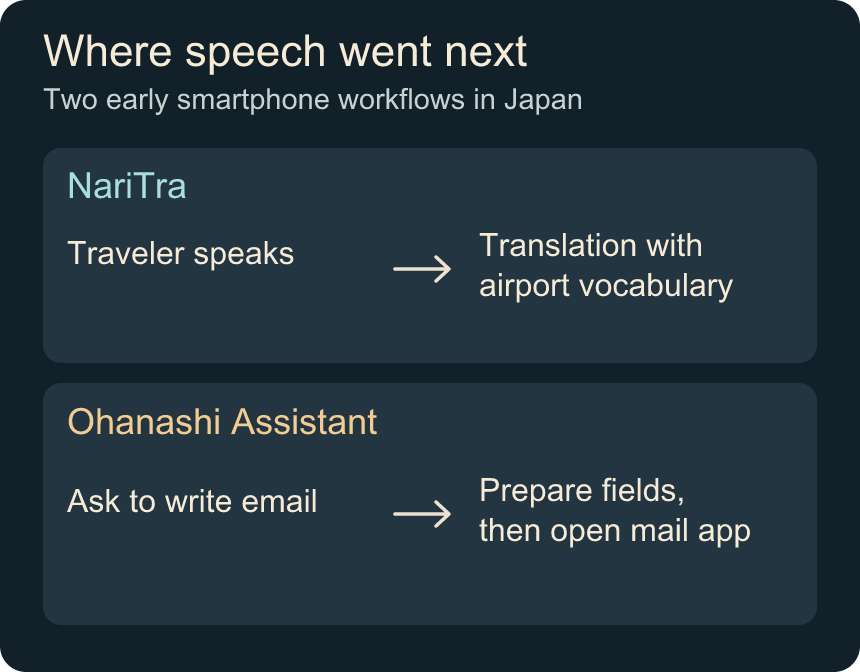
The airport edition had a dictionary that included names of facilities, stores, airlines and railway lines relevant to Narita. Consider a traveler trying to ask how to reach a particular train line. The route name has to survive translation because it tells the listener where to direct them. That gives the airport and the translation team a specific problem to work on. NICT had already released the underlying tool as VoiceTra, and the airport licensed the technology for its traveler app. NariTra archive.
Ohanashi Assistant carried a request into an existing app
KDDI and Okinawa Cellular announced おはなしアシスタント, or Ohanashi Assistant, for au Android phones in 2012. Its usage guide told people to open the app and tap the microphone at the bottom of the screen. What happened next depended on the request and the apps available on the phone. KDDI’s usage guide.
A spoken request to email your mother could set the recipient and let you compose the subject and message. Ohanashi Assistant then opened the phone’s email app. Asking how to get from Tokyo to Shinjuku opened results in one of au’s supported navigation apps. A request to buy milk and eggs could go into the installed memo app. The guide shows how the assistant fitted into software people already used. Ohanashi Assistant archive.
KDDI’s optional paid tier also let people log things they had eaten and places they had visited by voice. The same tier offered outfits and room decorations for the assistant character. KDDI said the items changed monthly, and how much someone used the app affected the available customization. KDDI’s feature sheet.
What remains in the record
A 2022 NICT report names both apps in its account of how the institute’s language technology reached public services. It records NariTra’s closure. NICT’s 2022 report. Its precise final service cutoff remains uncertain, and VoiceTra continued separately. Au lists July 31, 2018 as the end of Ohanashi Assistant. The old guides preserve the practical choices behind the two apps. At Narita, the spoken sentence needed to keep the names a traveler would hear and see. On an au phone, the spoken command needed to reach the app that could act on it. NariTra archive · au’s ended services list.