Civilization Chronicles
An anomaly on a chart, a voice in a file
Lookout for Metrics, Metrics Advisor and VoiceAI made anomalies and recordings easier to inspect through contribution charts, diagnostic trees and timestamped transcripts.
A revenue chart can tell you something changed without telling you where to look. A recording preserves what someone said without making a particular sentence easy to find. Amazon Lookout for Metrics, Azure AI Metrics Advisor and NeuralSpace VoiceAI each built an interface around that gap: moving from a large collection of signals to something a person could examine.
These are three historical product experiences, reconstructed from their original documentation and illustrations. The graphics below are original explanatory illustrations based on those sources. They are not product screenshots or tests we ran.
Amazon Lookout for Metrics: opening up the aggregate
In AWS's preview, an anomaly could be broken down by operating system, device, country or product type. Its impact display gave an investigator a way into a broad movement in revenue: which slices contributed most to the change? The blue bars in the historical example make that question visible before any model explanation. AWS preview.
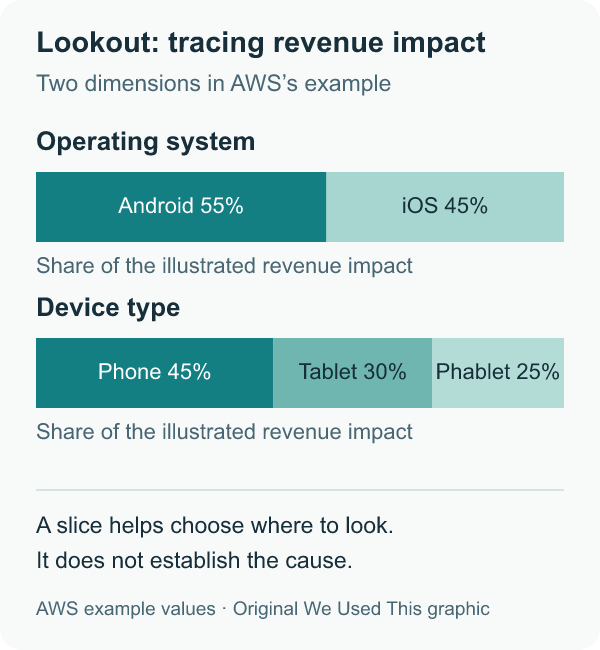
AWS later walked through a sample shop with revenue and page views, divided by platform and marketplace. An unusual point led to a group of related anomalies, a severity score and a closer look at the affected combinations. The useful interaction was the narrowing: a shop-wide number became a specific place to investigate. The walkthrough used sample data and does not establish a result for a real retailer. AWS product walkthrough.
A later root-cause feature added relationships between metrics. AWS's explanation explicitly distinguished potential causes from proof: statistical relationships could suggest a path through revenue, orders and profit, while causes outside the configured data remained outside the model's view. That limit belongs beside the feature, because an investigation still needed a person to test the explanation. AWS root-cause article.
Lookout for Metrics ended on October 10, 2025 and appears in AWS's completed-shutdown registry. Its story and service scope are preserved in the Lookout for Metrics archive. AWS lifecycle record.
Azure AI Metrics Advisor: keeping detection and diagnosis together
Microsoft's archived overview laid out a complete route through a monitoring task: ingest time-series data, detect unusual behavior, send alerts, then investigate. Its diagnostic tree grouped related anomalies across dimensions. A separate Metrics Graph represented relationships between metrics. Feedback let users tune detection to what mattered in their own data. Microsoft's product overview.
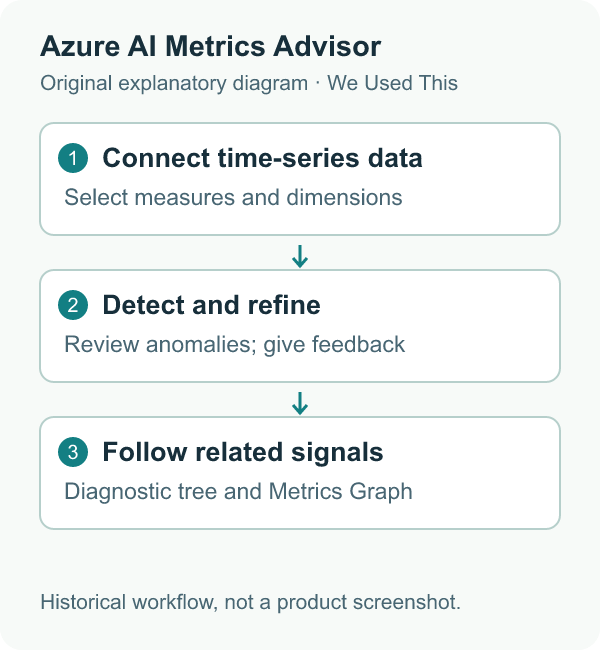
The documented workflow gave the alerts a destination. Detecting an unexpected value was one step; arranging related signals into something an investigator could follow was another. The tree and graph made that second task part of the same workspace. They offered investigative structure, not a guarantee that every incident's cause would be found.
Microsoft's current archived overview states that the service was retired on May 18, 2026. That completed statement takes precedence over older pages carrying a different planned date. The Metrics Advisor archive keeps that distinction and the product's scope with its sources.
NeuralSpace VoiceAI: giving a recording a readable position
VoiceAI approached a different kind of signal. Its original page described file and real-time transcription, speaker separation, word timestamps and audio analytics, with a focus on Arabic and Indian dialects. A no-code workspace sat alongside API and SDK access. Those are historical product descriptions, not independently verified accuracy claims. NeuralSpace's original product page.
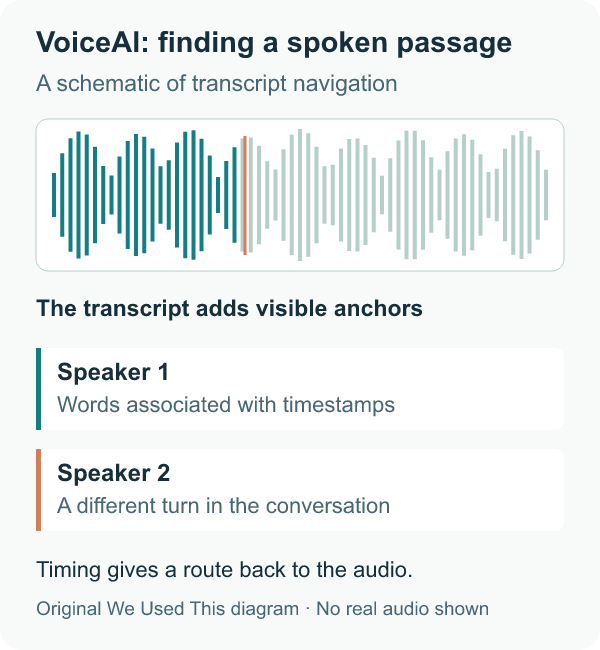
NeuralSpace’s promotional player illustration put a waveform above labeled turns and playback controls; its placeholder text was not a real transcription. The diagram here isolates the navigational idea: an otherwise continuous recording gains visible positions through a speaker and a timestamp. That presentation does not establish transcription accuracy or prove that every depicted control shipped exactly as illustrated.
The surviving page now says the services are unavailable. Founder Ayushman Dash places NeuralSpace's shutdown in 2025 in his September 22, 2026 retrospective. That publication day is an archive date proxy, not a 2026 service cutoff. The precise final day remains unverified in the VoiceAI archive.
A contribution bar, a diagnostic tree and a timestamped speaker turn preserve different ideas about where a person should look next. Keeping those details beside the closure record leaves more of each product available to remember.