Civilization Chronicles
Five AI products worth remembering for how they worked
Explore the real interfaces behind Artifact, Dot, Terragon, Google Opal and Jules, from news summaries to visual workflows and coding agents.
A news article could begin with a summary in the style of a poem. A coding task could continue in a cloud workspace while its owner did something else. A mini-app could reveal its instructions as a sequence of editable steps.
Artifact, Dot, Terragon, Google Opal, and Google Jules approached AI through different everyday interfaces. Some have ended; others are still scheduled to wind down. Their stories are easier to understand by looking at the things they actually let people do.
Artifact: a news summary above the article
Artifact began with a personalized news feed, but one of its most memorable additions sat inside an article. In April 2023, its team introduced a summary control: tap Aa, then Summarize, and a generated overview appeared above the original text.
The summary also had a playful side. A reader could choose a simpler explanation, a poem, or an emoji-only version. Artifact’s own announcement cautioned that generated summaries could contain mistakes and should be checked against the article. The original reporting remained there to read; the summary was an entrance into it, not a replacement for it.
Artifact no longer operates as a standalone app. Yahoo announced its acquisition in April 2024 and said the technology would be incorporated into Yahoo products. The precise final cutoff for the standalone app is not established by that announcement.
Read the Artifact record · Artifact’s summary announcement
Dot: a conversation that could remember a recipe
Dot, made by New Computer, treated a conversation as something that could carry context from one day to the next. In an early hands-on account, a reviewer described sending photographs of cookbook recipes to Dot, then asking it to retrieve a recipe and alter ingredients through conversation.
That example makes the idea tangible: a picture, a remembered preference, and a later question could belong to the same thread. The account also describes Dot offering follow-up suggestions and occasionally over-emphasizing an interest. Those are one reviewer’s observations, not a guarantee of how it behaved for every user.
New Computer ended Dot on October 5, 2025, after a farewell and an opportunity for users to request their data.
Read the Dot record · Fast Company’s early hands-on account
Terragon: a workspace for parallel coding agents
Terragon’s hosted workspace let developers delegate coding tasks to agents in cloud sandboxes. Its retained source snapshot describes each agent working in its own isolated copy of a repository, with task branches and changes pushed to GitHub. The same snapshot also describes a CLI for taking a task over locally.
The distinction was the shape of the work: instead of keeping every coding request inside one editor session, a developer could follow multiple tasks as separate pieces of work, inspect their changes, and bring a task back to a local environment when needed.
The original hosted service and its sandboxes had ended by February 9, 2026. That is a later confirmation date, not a verified exact cutoff; the team’s retained source snapshot already referred to shutdown in January. The source snapshot is separate from the former hosted service.
Read the Terragon record · Terragon’s retained source snapshot
Google Opal: a mini-app whose steps stayed visible
Google Labs’ standalone Opal builder used natural language to make AI-powered mini-apps. Its visual editor exposed the steps behind a workflow. In an October 2025 update, Google described running that workflow one step at a time and seeing an error at the step where it occurred.
In 2026, Google also described an agent step that could choose tools and route work based on a goal. One example prepared for a client meeting differently depending on whether the client was new or existing. It was a small but important interface choice: the app could respond dynamically while the builder still had a visual representation to inspect.
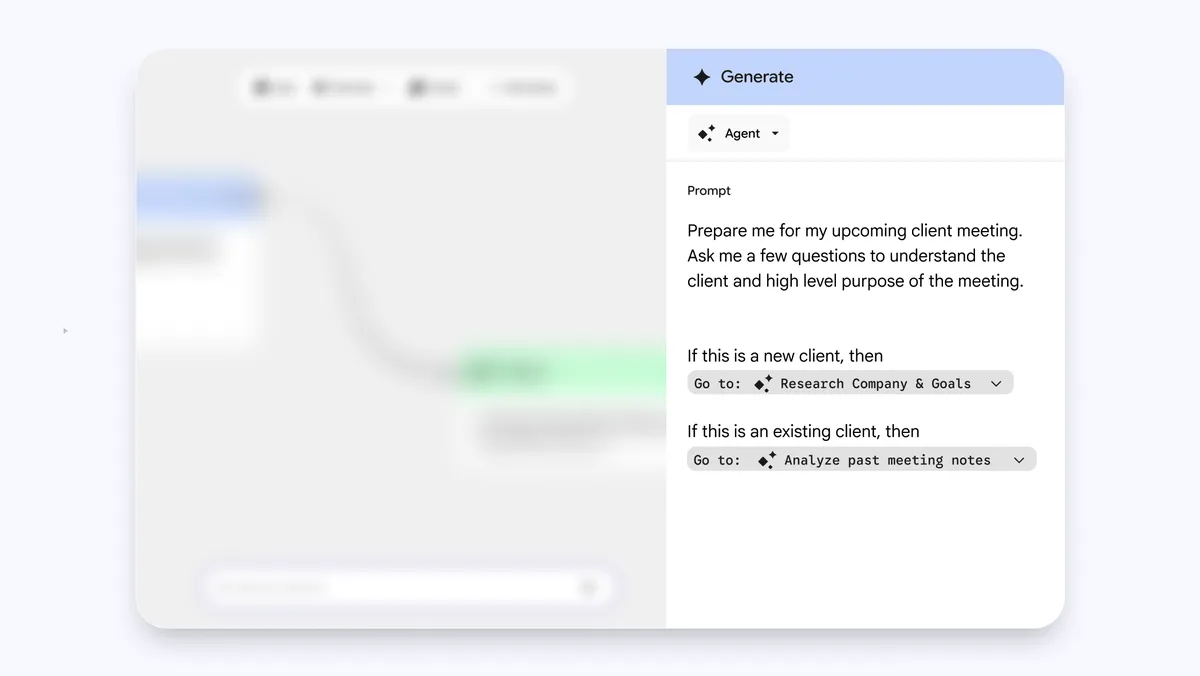
Google currently plans to turn off the standalone hosted Opal builder and interactive workflows on November 17, 2026. The archived record distinguishes that service from related Google products and retained Drive files.
Read the Opal record · Google’s visual-editor update · Google’s shutdown FAQ
Google Jules: approve a plan, then follow the work
Jules was designed for asynchronous coding tasks. Google’s public-beta introduction described connecting an existing repository, giving the agent a task, and reviewing a plan and changes while the work ran in a cloud virtual machine. It also showed an unusual feature for a coding tool: an audio summary of recent changes.
In Google’s example below, a request to add a harder mode to a game becomes a short plan with individual steps. The interface lets the developer inspect the plan before the agent continues. That moment—between a task written in ordinary language and changes to a repository—is where Jules made its workflow visible.
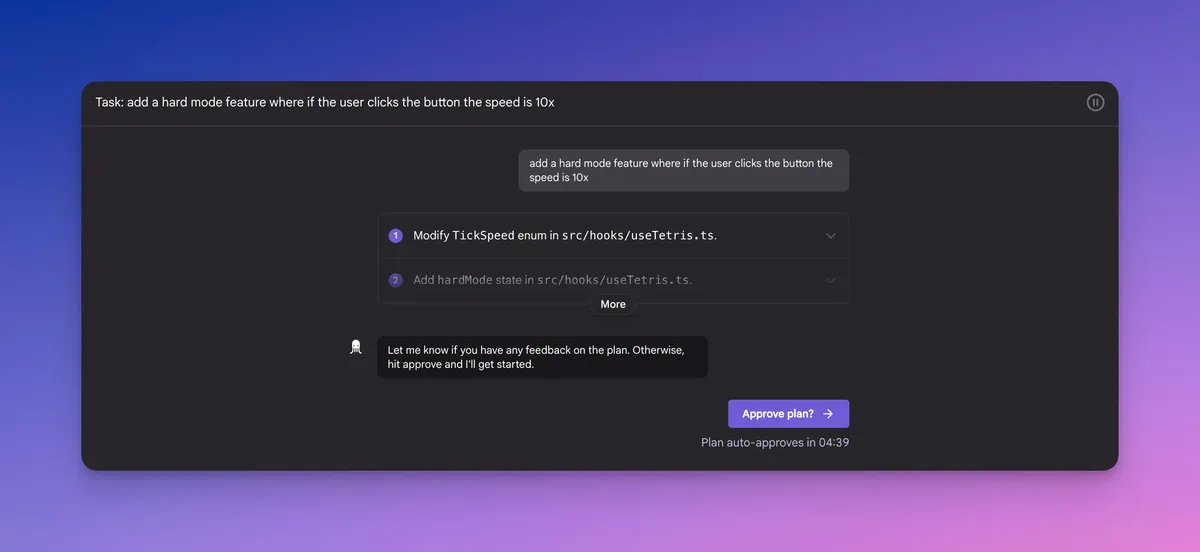
Google plans to wind Jules down on December 31, 2026. Its October notice says users have until November 11 to finish sessions, after which Jules becomes read-only through the end of the year. These are scheduled changes, not a claim that the service has already ended.
Read the Jules record · Google’s public-beta introduction · Jules wind-down notice
What remains
These products did not all solve the same problem. One helped a reader approach an article; another held a conversation over time; three made different kinds of work visible as steps or tasks. Their interfaces are reminders that an AI product is not only a model: it is also the controls, feedback, and small decisions around it.
The Civilization Archive keeps the dates, scope, and sources for each product. This article preserves a different part of their history: what it was like to encounter the work they were designed to do.