Civilization Chronicles
A voice intent, a spreadsheet cell, an object in a picture
Remember Snips Console’s intent and slot vocabulary, Charm’s text work inside Google Sheets, and Stable Assistant’s object and structure editing through their original product descriptions.
A city and a time inside a sentence. A column of untidy addresses. An object that needs changing in an otherwise useful picture. Snips Console, Charm and Stable Assistant offered different ways to work on these small pieces of an AI task.
This selection revisits their documented product ideas. The examples come from historical documentation and product descriptions; we did not run these services or measure their results. The diagrams are original explanatory compositions, not product screenshots or measured outputs.
Snips Console: giving a sentence an intent
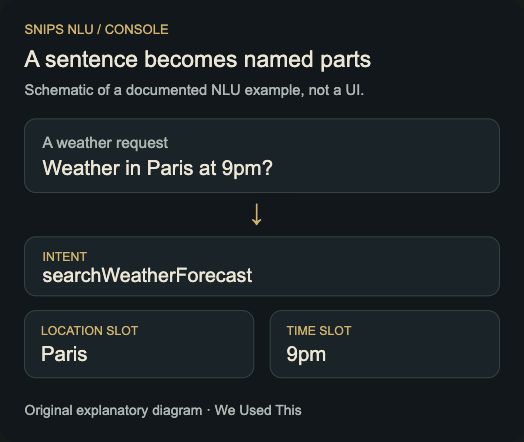
The Snips team’s NLU documentation uses a weather question containing Paris and an evening time. Its example output separates the request’s intent from the location and time slots. That distinction made the meaning addressable: a program could receive a weather request with named pieces of information instead of an undivided sentence. The example describes a properly trained engine, not a guarantee for every utterance. Snips NLU documentation.
The same documentation identifies this engine as powering Snips Console. Home Assistant’s contemporary report describes the Console’s role in training with custom sentences and intents. A person building a voice interaction could shape the vocabulary behind the assistant. The hosted development workspace and the assistant running locally were different parts of that workflow. Home Assistant’s account.
The Snips Console archive records the public workspace’s closure separately from downloaded assistants and the NLU library. Its displayed deadline is an expressly inferred date proxy.
Charm: keeping text work inside the sheet
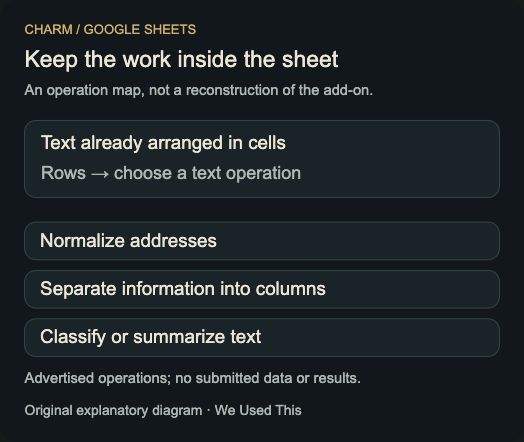
Charm placed text transformations in Google Sheets. Its product page describes normalizing addresses, extracting entities and separating information into columns, alongside summaries and text classification. A sheet containing inconsistent text could become the working surface for a language task. Charm’s original product page.
The supplied templates gave that work recognizable names. Product feedback could be categorized; an existing passage could become a shorter summary; product descriptions could be rewritten into variations. An editor also let users define their own templates. These were the maker’s advertised operations, not results from a spreadsheet we submitted.
That placement matters to the product’s identity. Instead of treating every item as a separate conversation, the add-on addressed text already arranged as rows and columns. It combined a familiar data structure with transformations that conventional formulas did not readily express.
Charm’s completed-state banner and maker’s notice name September 15, 2023 as its shutdown date. The Charm archive preserves that record. Maker’s notice.
Stable Assistant: changing one part of a picture
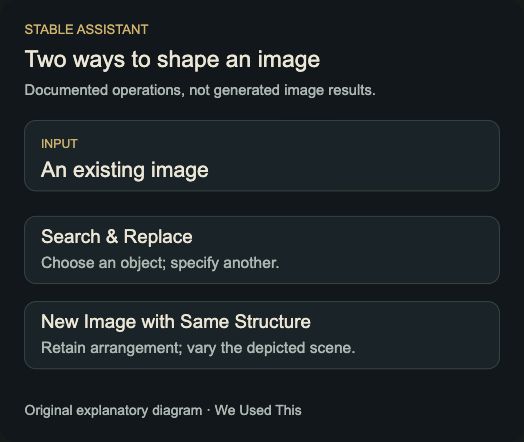
Stable Assistant packaged creative tools in a chatbot. Stability AI’s feature article describes uploading an image, specifying an object and replacing it with another. Its structure-preserving image option offered a different kind of variation: retain an input’s arrangement while changing what the new image depicts. Stability AI’s feature article.
The article’s coffee-cup examples change the surrounding setting from forest to desert. That pair makes the intended operation easier to understand than a general promise of creative freedom. The starting image supplied something to retain as well as something to change.
Other documented tools extended an image beyond its edges, worked from a sketch, removed a background or increased resolution. The product gathered several operations around an existing visual, alongside other media features. These are historical capabilities described by the operator; their availability and fidelity were not independently tested here.
The operator’s notice gives October 1, 2026 as the application’s sunset date. The Stable Assistant archive explains the date basis and named-app scope. Deprecation notice.
An intent and its slots, a set of cells, a picture with a particular object: these products left different handles for a person to work with. Remembering those handles preserves more of their purpose than an end date alone.